about

what´s on

exhibition
screening
performance
sound
e-news
past exhibitions

upcoming

learn


parabol - sound shower
Banner

Parabol - a series sound works at 3,14 curated by


Lydgalleriet (The Soundgallery) is an artist run gallery for sound art and related practices. Since 2005 the gallery has provided Bergen audiences with sound art and experimental music in public space and different temporary locations. Currently Lydgalleriet runs a small white cube at USF Verftet.

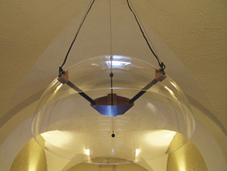
The parabolic speaker in the entrance hall of Gallery 3,14 is curated by Lydgalleriet.
Lydgalleriet expands 3,14s exhibition experience with complimen-ting, commenting and /or compromising sound works.


Le Tigre
Hot Topic (1999)
FYR
(2001)
Initially envisioned as a live back up band for Hanna's solo project Julie Ruin, Le Tigre mixed the politics and feminism of riot grrrl with electronic samples and lo-fi beats. Other members included Johanna Fateman and JD Samson. JD joined Le Tigre as a full member when co-founder Sadie Benning left the band before the Feminist Sweepstakes album was recorded. JD had previously worked with the band as a roadie and the operator of Benning's slide show during live performances in support of their first record. The self-proclaimed "underground electro-feminist performance artists" combined visuals, music and dance in their performances. JD is agay rights activist, and the excerpts in "New Kicks" are from an actual protest that JD recorded herself. Hanna is a public speaker against sexual abuse.
The song "Hot Topic" on Le Tigre's self-titled debut pays tribute to dozens of female visual artists, musicians, writers, feminists and others who have inspired them. Among those mentioned are: Yoko Ono, Cibo Matto, Aretha Franklin, Vaginal Cream Davis, Yayoi Kusama, Angela Davis, Sleater-Kinney, The Slits, Billy Tipton, Laura Cottingham, James Baldwin, David Wojnarowicz, Justin Bond and Hanna's close friend, Tammy Rae Carland. In a similar fashion the song "FYR" off the album Feminist Sweepstakes is a tribute to the chapter and ideals put forth in Shulamith Firestone's Fifty Years of Ridicule in her 1970 feminist work The Dialectic of Sex. The album contains a sample of an essay written by Mark Rothko in response to a negative review in 1942 where he debuted the style he would become famous for.

20.08. - 03.10.10

Zhang Liming (aka Hitlike)
A Gift of Dispair for My Friends
(2009)


Zhang Liming (aka Hitlike
), born in Chifeng, Inner Mongolia, 1981, programmer, field-recordist, now living in Harbin, Northeast China.
He defines himself as a mere listener who, since 2002, occasionally creates field-recording based sound works that are concerned with acoustical textures and the meeting between the subject and environmental objects. As an unsociable person, he spends most of his time roaming the internet, through which he also releases his works.

In 2003, Zhang’s first soundscape album Summery Shuangjing Sound Sections, recorded in his hometown with a low-end mono cassette recorder, was released online. Later the same year he launched the Harbin Ice-breaking Social Organization with several friends to research and discuss any noteworthy events or issues in the art scene. After two further experimental net-releases and a part in the compilation The Sound of Silence (reconfiguration records), his debut CD in was released by Little Sound, China’s respected 3” CDR label, in 2006. The track Walking from this album was included in the China Power Station Part I exhibtion at Battersea Power Station, London, 2006.
Zhang have taken part in We-Need-Money-Not-Art, a translation workgroup for the new media art blog We-Make-Money-Not-Art, and he is also the founder of the Sound Art Forum at Douban.com

30.04. - 30.05.10

Yoichi Nagashima
Coin´s Journey
Yoichi Nagashima, composer/researcher/PE, was born in 1958 in Japan. He learned and played some instruments: violin, recorder, guitar, keyboards, electric bass, drums, and vocal/choral music for 35 years. He was the conductor of Kyoto University Choir and composed over 100 choral music, and studied nuclear physics there.
As the engineer of Kawai Musical Instruments, he developed some sound generator LSIs, and designed some electronic musical instruments, and produced musical softwares. From 1991, He has been the director of ”Art & Science Laboratory” in Japan Hamamatsu, produces many interactive tools of real-time music performance with sensor/MIDI, cooperates some researchers and composers, and composes experimentally pieces. He is also the key-member of Japanese computer music community.
From 2000, he has also been the associate profrssor of SUAC (Shizouka University of Art and Culture), Faculty of Design, Dapartment of Art and Science, and teaches multi-media, computer music and media-art. As a composer of computer music, he collaborates with many musicians in his composition: Piano, Organ, Percussion, Vocal, Flute, Sho, Koto, Shakuhachi, Dance,
etc... He organized and was the General Chair of NIME04.
On April 2007 he became a professor.

14.08. - 04.10.09

Alexander Rishaug
My Favoutite Place (2004)
"My favourite Place er et stykke som kombinerer digitale lyder, feltopptak og et sample fra mitt Magnus luftorgel. Det inngår på min andre soloplate Possible Landscape som ble sluppet på Asphodel i 2004. Et flytende harmonisk landskap danner fundamentet, hvorpå en raslende rytme stykker det hele opp. Ulike feltopptak passerer i sakte tempo, en skranglende leke, en stemme eller en dör som lukkes. Min nabo sin papegøye sang av full hals ut i bakgården. Jeg firte ned med min mikrofon som om jeg var en russisk spion på hemmelig oppdrag. Senere har jeg fått vite at den rømte og forsvant. My favourite place
handler om steder en liker å være; huset ved havet, cafeen ved parken eller leiligheten i femte."

Alexander Rishaug is a sound artist and electronic musician based in Oslo, Norway. A member of the country’s fertile experimental music scene, Rishaug has toured throughout Europe and the US and appeared
on compilations on the Rune Grammofon, Jester and Smalltown Supersound labels. His first full-length, the critically acclaimed Panorama, was released in 2002 by Smalltown Supersound. Also a member of the improv trio ARM with Arne Borgan and Are Mokkelbost (Single Unit), Rishaug has collaborated with numerous
other artists including Håkon Kornstad, Pål Asle Pettersen, Tonny Klyften, John Hegre, Jørgen Træen, Toshimaru Nakamura and Salvatore.
03.07. - 09.08.09

Taylor Deupree
Weather & Worn
"Created in a short number of days, “Weather” and “Worn” actually mark the first recordings I have done solely with acoustic instruments and a minimum of effect processing. Although not entirely planned, these two pieces are quite fittingly warm and a bit noisy, scratchy and tactile. Each track is based around a drone and then extended by further explorations around the same note. There is a stillness and feeling of tension which then give way to clarity. When the work is played loudly, it becomes ever-present, yet is gentle and calm when played softly. There is a sense of struggle between the weather and my mood, between the technology and imperfection..."

Taylor Deupree (b. 1971) is an American electronic musician, graphic designer, and photographer residing in New York. In 1997, he founded 12k, a record label that focuses on minimalism and contemporary musical forms. In 12k’s 12 years of existence Deupree has released over 60 CDs by a roster of international sound artists and has developed 12k into one of the most respected experimental music labels in the world. Rooted in minimalism 12k’s sound has evolved over the years to incorporate the hyper-synthetic elements of minimal techno to acoustic avant garde and instrumental post-rock. In September 2000, Deupree and sound artist Richard Chartier formed LINE, a sublabel of 12k that curates its continuing documentation of compositional and installation work by composers exploring the aesthetics of contemporary and digital minimalism. In January 2002 (as a celebration of 12k’s fifth anniversary) Deupree launched term., an online series of MP3 releases. While 12k’s emphasis lies not only in sound but also on design and presentation, term. exists entirely in the digital domain with no physical object or package. In September, 2003, Deupree started a 3rd record label called Happy to promote unconventional japanese pop. Happy was born from Deupree’s interest in Japanese pop and the fact that it is quite unknown outside of Japan. In 2007 Happy was folded into 12k as the sounds of the two labels started to merge.
08.05. - 28.06.09

Gregory Whitehead
Project Jericho (2004)
Docufictional report, BBC3, produced with Mark Burman, duration of complete program: 19:30
Gregory Whitehead uncovers the latest attempts to harness sound as a weapon.
A mock-umentary about the Jericho Institute, where the U.S. Army is researching sonic weapon applications of the Voice of God.

Gregory Whitehead is a writer, audio artist, and the director of sea-crow media. He has produced over fifty radio features, voice works, and earplays for programs in the United States and abroad. Drawing on his background in improvised music and experimental theater, Whitehead has created a body of radiophonic work distinguished by its playfully provocative blend of text, concept, voice, music, and pure sound. Production credits include: Dead Letters, Pressures of The Unspeakable (Prix Italia, 1992), and New American Radio commissions: Lovely Ways to Burn (1990), Shake, Rattle and Roll (1992) (BBC Award, Prix Futura, 1993) and The Thing About Bugs (1994). He is also the author of numerous essays on subjects relating to language, technology, and “the public”, and he co-edited Wireless Imagination: Sound, Radio and the Avant-Garde, a selective history of audio and radio art (MIT Press).
20.03. - 03.05.09

Dragan Todorović
In my language I am smart (2003)

Dragan Todorović (Serbian: Драган Тодоровић; born in September 1958 in Kragujevac, PR Serbia, FPR Yugoslavia) is a writer and multimedia artist. Until 1995 he lived in Yugoslavia, where he worked as a journalist, editor, and TV personality. Todorović continued to write after moving to Canada during the early 1990s. He published in the Toronto Star, This Magazine, Saturday Night, NOW, Ottawa Citizen and other Canadian publications.
In September 2005 Todorović moved to England. His memoir, titled The Book of Revenge, was published in March 2006 by Random House. It was awarded the Nereus Writers' Trust Non-Fiction Prize, and nominated for British Columbia Award for Canadian Non-Fiction.

“Although I have learned English relatively early, and studied it through the better part of my school years, when I came to Canada to live here in 1995 I realized quickly that I had a problem. It was not so much with my vocabulary, or my spelling – on the contrary, that part of my education was very good – but with the precise meaning and finesse of expression. The sentences I learned to use, the constructions, the tone – all came from the Hollywood movies and rock and roll, and these areas mostly use brutal, short-cut constructions. Of course, I was thinking in my mother’s tongue – Serbian – and translated my thoughts, but that didn’t help for two reasons: either I was slow with this process, and by the time I had my precise meaning translated in English the conversation had shifted in some other direction, or I would come up with a quick construction that only the most benevolent person would care to decipher. 
But my biggest problem was the sound of my English. Language is acquired with its sound, and the sounds I had picked from records and movies were harsh, aggressive, and presented me in a very different light from who I was and am. Suddenly I realized that somewhere in the process of acquiring the tone of modern English I had lost my identity. It was painful to realize that in my language I was smart, but I sounded stupid in English. Example: while walking with my Canadian friend one day by a church, he started talking about the architecture of that particular building, and while I wanted to say a few things about how I liked the Gothic details on the arch at the entrance, and how I admired the intelligent choice of stones, all I could squeeze out was, “Yeah, it’s cool”. 
Acquired meaning is superficial. Sound puts word into context, but the deeper shades of expression are not learned. I responded the way that Clint Eastwood, or some other action hero, would in one of their roles. Back in Serbian language I was connoisseur of arts; in my newly acquired language I was a cop.”

21.01. - 06.03.11

Alice Hui-Sheng Chang
The aqua moon behind the green sunset is nearly visible. (2006)
Extended vocal technique has been Alice Hui-Sheng Chang’s main focus since end of 2003. She improvises with extended vocal technique in hope of evoking a psychological connection to the indescribable feelings. Her work explores various combinations of layering and interactivity of extended techniques via interaction with the soundscape and acoustic properties of the environment, with attention to visual and spatial associations. Through these sounding, movement and listening experiments, she explored condensing and extracting of inner energy, in-site and spatialisation between collaborators, as well as the harmony and dissonance between them.

Alice Hui-Sheng Chang born in Changhua, Taiwan, 1984. Alice Hui-Sheng Chang finished her degree in Master of Fine Arts (sound) at RMIT-Royal Melbourne Institute of Technology University in 2006. She was awarded with a School of Art Award and was chosen to represent RMIT to be part of the Hatched 07, National Graduate Show in PICA, Perth. She received a Bachelor of Arts (Media Arts) with Distinction, RMIT in 2005, majored in sound and video. During those years, she has received grant from RMIT Union Arts in 2005. Her video work Flat had also awarded as Best Experimental in RMIT Film and Video Awards 2004. She had been involved in the selection committee of First Site Gallery and RMIT Film and Video Awards 2005.

08.10. - 14.11.10

Wang Zheying
Google Secrets (2010)
Wang Zheying (1983) belongs to the 90’s generation of Chinese musicians who bypassed government cultural restrictions, and absorbed outside music through Internet file-sharing and black-marketed Western CDs that were originally shipped to China for disposal. He has had concert throughout the world and his sound works has been exhibited in Europe and the US.
Google Secrets is a response to the Chinese censorship of the Google search engine. The whispered words are the blacklisted search phrases on Google's chinese version
.
15.01. - 21.02.10

Jörg Piringer
"Sorted Speech" (2009)

Using speech recognition Piringer analyzed a video of a speech by Barack Obama. He then sorted the snippets (containing a word each) alphabetically.
The rhetoric and persuasive nature of the American president’s talk is spelled out as statistics. On the one hand, it looses it’s original meaning, but on the other hand, it gains another poetic and thought provoking  significance. The different sounds of the same word or the number of repetitions of certain words. Everyone knows voice of Obama, but here, it is reduced to a vehicle of his own words.
Jörg Piringer (b. 1974). Currently living in Vienna, Austria. Member of the Institute for Transacoustic Research. Member of The Vegetable Orchestra (Das erste Wiener Gemüseorchester). Student at the Schule für Dichtung in Wien (Curd Duca, Sainkho Namtchylak, etc). Master degree in computer science. Sound poet.
06.05. - 19.06.11

Espen Sommer Eide (Phonophani)
"Kreken II" (2010)
Kreken II is an installation version of the title track off the fourth album from Phonophani, aka Espen Sommer Eide. While he has previously turned his attention to other cultures and traditions, with ”Kreken” he turned his ears to Norway´s own traditional folk music and instruments, it´s melodic content and special tuning systems. His music is about rediscovering the great mystery of music through dissecting the sound of ordinary or real world instruments and dissolving melodies into their elementary particles. The sounds of Kreken II are originally from recordings of the traditional Harding fiddle (hardingfele) and the accompanying stamping feet of the player. The Harding fiddle is a traditional stringed instrument used originally to play the traditional music of the southwest part of Norway. The instruments are similar to the violin, though with eight or nine strings (rather than four as on a standard violin) and thinner wood. Four of the strings are strung and played almost like a violin, while the rest, aptly named understrings or sympathetic strings, resonate under the influence of the other four, providing a pleasant haunting, echo-like sound. The earliest known example of the Harding fiddle is from 1651, made by Ole Jonsen Jaastad in Hardanger.

Espen Sommer Eide (Tromsø, 1972) is a musician and artist currently living in Bergen. He composes under the alias Phonophani, and as a member of the band Alog. Live he uses elaborate setups of custom made instruments, hybrids combining electronic and acoustic elements. He has several releases on the record label Rune Grammofon. Alogs album "Miniatures" was awarded the Norwegian Grammy-award (Spellemannprisen) in 2006. In addition to touring extensively with his musical projects, Eide also has produced a series of site-specific pieces and artworks, and is currently a member of the theatre-collective Verdensteatret, involved especially with building instruments and sound design.

These projects include composing and performing music for the 50-year anniversary of Le Corbusiers chapel in Ronchamp, France, the sound art installation Sonus Barentsicus for the Northern Lights Festival in Tromsø, Norway 2007, and a special performance at the Manifesta7 biennale in Italy, where local vinyl records were reconstructed into new musical instruments. Currently he is working on a permanent installation for the Eastern Sami Museum in Neiden, Norway. Eide has also been involved in a series of net-art projects with various topics connected to the Barents and arctic regions of Northern Norway, under the heading of "rural readers". In addition to making music and art, Eide has also been directing the Trollofon electronic music festival in Bergen (2001-2006), and works as artistic developer at BEK (Bergen Center of Electronic Arts).
24.06. - 14.08.11

Cécile Babiole
"Stitch´n Glitch" (2011)
In this piece of performance art I pursue three of my “pet projects”:
- First off, working with machines and with dying industrial or handicraft techniques, which are transfigured into sound generators, for one last “swansong”, in my performances and installations.
- Secondly, putting together an experimental girls band, The Black Needles, with four other women artists from Mulhouse. In our music we revisit zigzag stitching, buttonholes and machine-sewn hems, transforming these tasks traditionally relegated to women into a special blend of sound art.
- And lastly, on an aesthetic level, fusing musique concrète and synthesized music in a performance combining the amplified direct sound of machines and the selfsame sound sculpted by audio synthesis tools : I use piezo microphones to capture the vibrations of sewing machines and feed them in real time into a granular synthesis program.

Cécile Babiole (1962)
From industrial music in the 1980s (with the band Nox) to an exploration of electronic and digital cultures in our day, Cécile Babioleʼs artistic trajectory has evolved laterally, cutting across the realms of music and the visual arts. Far from de rigueur interdisciplinarianism, her works move back and forth between one language and another, bleeding each code into the other in an ongoing reinterpretation of the relationship between image and sound.
Whether staged in the public realm (streets, busses) or in private venues (galleries, concert halls), her latest installations and performances (RPM, Shining Field, Doom, Iʼll be your Mirror, Circulez yʼa rien à voir, Reality Dub, Crumple Zone...) question our prevailing systems of representation – from an original and ironic angle.

Awards:
Imagina 1992, Images du Futur 1992, Ars Electronica 1992, World Graph award Locarno 1992, bourse Villa Médicis hors les murs 1993, internet award from la SCAM 1999, Transmediale Festival Berlin 2003, Stuttgart Film and Expanded Media Festival 2004, Aide à la maquette DICREAM 2004, aide à la création multimédia Arcadi 2004, Aide à la création multimédia Arcadi 2009, Bourse brouillon dʼun rêve de la Scam 2009, Aide à la maquette DICREAM 2009.
la Filature, Scène Nationale à Mulhouse associated artist for 3 years from January 2008.

19.08. - 25.09.11

Ross Bolleter
"Ruined Piano: Unfinished Business" (1987)
I discovered the Ruined Piano in June 87 when Glenys my wife suggested we have a family holiday with our children Amanda and Julian at Nallan Sheep Station. After we had been there a day or so April Peterson, one of the present owners of Nallan Station, told us about a neglected piano in one of the sheds. I wasn't keen to look at it; this was meant to be a holiday and I'd seen wrecked pianos before.
This one was so totally done for however that I was totally won over. I had been preparing a variety of pianos - both uprights and grands - during the preceding three years, but this one, without the festoon of guitar jacks, rubbers, coins and pegs that I normally use, was "prepared" beyond any piano I had played or heard. Having brought a Marantz CD 330 and a pair of microphones to record an ambient tape of the crickets and a variety of sheep station sounds, I immediately hung the microphones over the rafters and made a recording of the Ruined Piano. With a variety of bugs crawling in concentric circles on the decaying front panel of the 'piano' as I played and with birds singing, roosters crowing, generators starting up, the owners complaining; in short, everyone and everything having its say, the recording turned out to be a lusty union of the environment and the piano.
The piano, that arch symbol of European musical culture (and cultural imperialism) in its present location and condition as the Ruined Piano functions is a dead end sign for the Northern Hemisphere traditions and styles that we have so gratefully and eagerly adopted in Australia. At Nallan sheep station all this is reduced to a debris of rotten wood and rusted wire. Re-entering the soil it is absorbed into the voices of the crickets and birds.

Ross Bolleter (born 1946, Subiaco, Western Australia) is an Australian avant-garde composer and improviser notable for his experimentation on ruined pianos. He has been a member of The Blackeyed Susans and he is a co-founder of the WARPS Music label. Bolleter started his career by practicing improvised music with the flautist Tos Mahoney. He later went to study music, including theory, history and composition, at the University of Western Australia, between 1964 to 1967. This re-awoke his interest in the music of composers such as Anton Webern, Karlheinz Stockhausen and Pierre Boulez, whom he had studied as part of his course. He then went investigating non-conventional timbral and rhythmic possibilities of the prepared piano. In the last 10 years Bolleter has explored playing with ruined pianos, that is old pianos that have been found after having been left exposed to the action of time and weather, thus acquiring novel and unexpected musical possibilities.
20.01. - 26.02.12

Loc Phuong
Prepare for F1 Student Visa Interview Answers (2009)
"Here you can prepare yourself for the questions in the F1 Student Visa Interview. I propose answers that will benefit your application. Answer the questions as I say, and you will probably get in to the US."
Loc Phuong is a Vietnamese student at the Lutherian South Academy.
11.03. - 30.04.11